
WhatsApp:+86 139 6595 5948

Upgrade your finishing with our Powder Coating Production Line & complete Electrostatic Powder Coating Solution. High efficiency, consistent output. Get a quote!
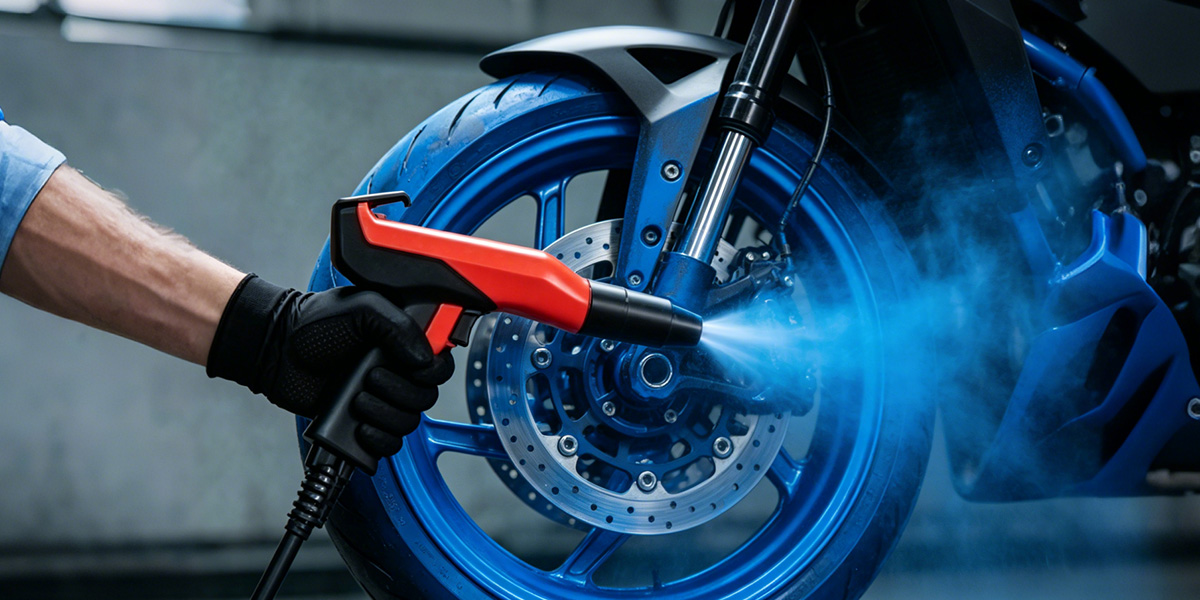
The motorcycle frame powder coating process consists of four main stages: “pretreatment → drying → powder spraying → heat curing”.
1. Pretreatment stage: An automatic spray or immersion/spray system thoroughly removes oil and rust from the frame. Chemicals used include rust removers, degreasers, surface conditioners, and phosphating agents. Because frames are large irregular parts, an extended spray tunnel is preferred. To comply with environmental regulations, phosphate‑free degreasers and silane treatment can replace traditional phosphating, achieving zero heavy‑metal discharge.
2. Powder spraying: A heavy‑duty overhead conveyor moves frames at a constant speed through an automatic powder spray booth. Multiple X/Y reciprocators or explosion‑proof robots with electrostatic guns are arranged on both sides, ensuring powder cloud fills the frame space. For complex frame cavities, “normal‑type nozzle kits” or extended side nozzles are used to achieve effective coverage in deep recesses. Frame coating typically requires 3 or more electrostatic spray passes, achieving a film thickness of at least 100 μm for a uniform and smooth surface.
3. Curing: After spraying, frames enter a large curing oven at 180–220 °C for a dwell time of 10–15 minutes. The oven must have a hot‑air circulation system to ensure uniform temperature distribution and avoid color or gloss variations.
Overhead conveyor system: Heavy‑duty chain with 5‑ton capacity, suitable for stable transport of large, heavy frames.
Automatic reciprocating powder sprayer: Stroke 1500 mm, reciprocation accuracy ±2 mm, speed adjustable 0–6 m/min.
Large cyclone recovery system: Efficiently recovers non‑adhering powder, increasing powder reuse.
Explosion‑proof collaborative robot (optional): Can track and spray moving frames, achieving a first‑pass yield of 99% or higher.
Excellent adhesion: Powder coatings have high volume resistivity (10¹⁰–10¹⁶ Ω·cm). Adsorbed powder particles release charge slowly, allowing continuous attraction and eventually forming a dense coating.
Clear environmental advantage: Powder coatings contain no solvents, emitting minimal VOCs and imposing a lower environmental burden.
Higher production efficiency: A case study at Loncin Motor showed that by developing in‑house electrostatic coating technology and continuously optimizing the process, the first‑pass yield gradually increased to about 90%.
Strong flexible production capability: The fast color‑change system supports small‑batch, multi‑variety customized production.