
WhatsApp:+86 139 6595 5948

Get superior coverage with Electrostatic Powder Coating Solution & high-efficiency Electrostatic Powder Coating Equipment. Reduce waste, boost productivity. Quote now!
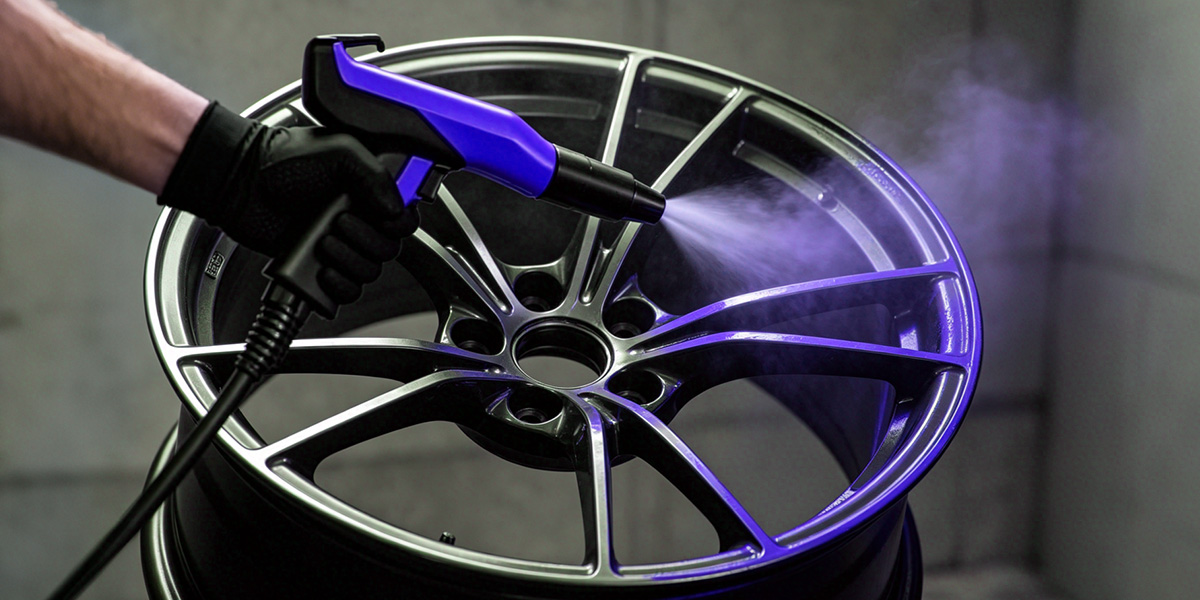
Automotive wheels are a key exterior component, and their coating quality directly affects the overall vehicle finish. Wheels have a complex geometry that includes inner rims, spokes, and edges. Manual spraying often fails to achieve 360° uniform coverage. This solution uses a fully automatic production line to achieve high precision, high efficiency, and high environmental performance in wheel coating.
The wheel powder coating line follows the standard sequence: “loading → degreasing → water rinsing → conversion coating → powder spraying → curing → unloading”. Detailed steps are as follows:
1. Pretreatment section: An 8–12 tank 316L stainless steel pretreatment system performs degreasing, water rinsing, surface conditioning, phosphating (or chromium‑free conversion coating), and drying. Chromium‑free conversion coating meets corrosion resistance requirements of 1,000+ hours in salt spray tests while reducing water consumption by 60%. Thorough degreasing and derusting before powder spraying is essential to ensure coating adhesion.
2. Powder spraying section: 4–6 six‑axis explosion‑proof robots form an automatic spraying cell. Robot positioning repeatability is ±0.1 mm. Electrostatic rotary bells operate at speeds above 20,000 rpm. Robot programming mimics a “wraparound” spraying path to ensure that every groove – inner rim, spokes, edges – is uniformly covered. Spray voltage is generally controlled between 60–90 kV, and powder particle size ranges from 10–80 μm.
3. Curing section: After spraying, wheels enter a hot‑air circulating curing oven at 180–200 °C for 15–20 minutes, allowing the powder to melt, level, and chemically react into a dense film.
4. Cooling and quality inspection: After cooling, gloss and thickness meters are used to inspect coating quality.
Spray robots: 6‑axis explosion‑proof, payload 5–15 kg, with a fast color‑change system for multi‑model production. Changeover time is reduced from 2 hours traditionally to 15 minutes.
Intelligent powder feeding system: Equipped with a large cyclone recovery unit; powder recovery rate >95%, reducing paint waste by 80%.
Process database: Stores over 500 wheel type parameters; an adaptive environmental control system regulates temperature and humidity with ±1 °C and ±3% RH accuracy.
Exhaust gas treatment system: Uses activated carbon adsorption, RTO, or zeolite rotor concentration; treatment efficiency >98%.
This solution has achieved remarkable results in automotive wheel coating. Coating thickness accuracy is within ±5 μm, material utilization rises from 30–40% to over 70%, VOC emissions are reduced by 90%, and the defect rate drops from 8% to below 0.5%. It enables fully automated, efficient wheel coating that meets the stringent quality standards of premium automotive brands and aligns with the latest national standards such as GB/T 13492‑2025 for automotive coatings.