
WhatsApp:+86 139 6595 5948

Boost throughput with our Powder Coating Production Line and advanced Electrostatic Powder Coating Equipment. High efficiency, consistent finish. Get a quote!
Automotive and motorcycle parts vary widely in shape – from precision components such as engine brackets and brake calipers to large structural parts like chassis components and door inner panels. Their coating requirements differ significantly. This solution uses highly adaptable, modular electrostatic powder coating equipment to address the challenges posed by different part geometries.
An electrostatic powder coating system for automotive parts mainly consists of the electrostatic powder spray gun, powder feed unit, compressed air system, and powder recovery unit. A complete production line also requires pretreatment, curing, and environmental protection systems, forming a closed‑loop coating line.
Spray voltage: Controlled between 60–90 kV. Above 90 kV may cause dielectric breakdown; below 60 kV results in insufficient electrostatic attraction.
Powder particle size: Optimal range 10–80 μm, with a narrow distribution. Near‑spherical particles are better for charging and melt flow.
Film thickness: Generally 50–100 μm; for heavy corrosion protection (e.g., frames) it can exceed 100 μm.
Curing conditions: The actual part temperature must reach above 180 °C for a cumulative dwell time of 10–15 minutes, not simply based on the oven set temperature.
1. Internal cavities and deep grooves: Hard‑to‑coat areas such as internal cavities, holes, and deep grooves are addressed by optimizing gun angle, zone spraying, using dedicated fixtures, or applying a conductive primer to improve the electrostatic field distribution.
2. Multi‑substrate adaptability: For different substrates (steel, aluminum, magnesium alloy, etc.), appropriate powder resin systems are selected. Epoxy powders are used for anti‑corrosion primer layers; polyester, fluorocarbon, or modified polyester for topcoats to improve weatherability.
3. Edge coverage optimization: High‑edge‑coverage powder coatings are formulated to reduce powder loss on sharp edges caused by rapid charge leakage. The surface resistivity of the powder coating must be sufficiently high to prevent premature charge dissipation at edges and corners.
4. Automation precision for irregular parts: Collaborative robots are used for electrostatic powder application on irregular parts, ensuring uniform coverage. In explosive‑proof environments, explosion‑proof robots are mandatory.
This comprehensive solution must be paired with environmental and safety equipment meeting national standards. For exhaust gas treatment, RTO (≥98% efficiency), activated carbon adsorption + catalytic combustion, or zeolite rotor concentrators are recommended. For safety, operations must comply with “Safety Code for Coating Operations – Safety of Electrostatic Powder Coating Process” (GB15607‑2008), including flame detection interlocking, gas pressure monitoring alarms, etc. Additionally, the spray booth must be enclosed and equipped with a dust collection system to meet environmental impact assessment requirements.
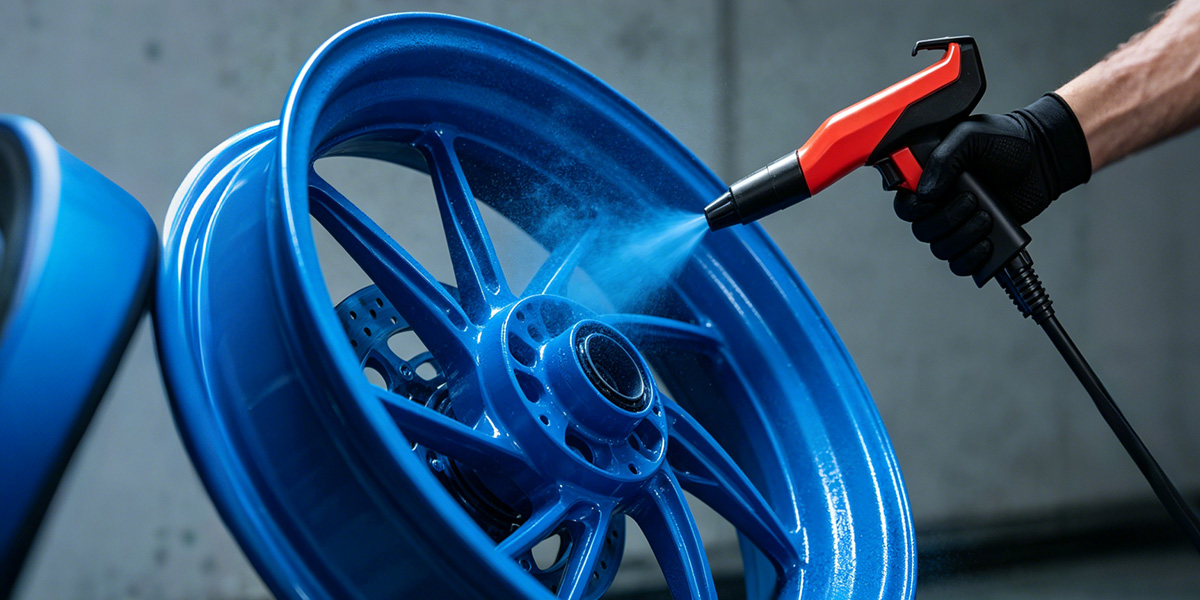
Electrostatic powder coating equipment is playing an increasingly important role in the coating of automotive and motorcycle parts. From high‑precision automatic coating of automotive wheels, to complete coverage of complex motorcycle frames, to highly adaptable spraying of various parts, electrostatic powder coating technology – with its excellent corrosion resistance, clear environmental advantages, and high automation capability – has become a key driver of transformation in the coating industry.
With the growing demand for lightweight components in new energy vehicles and increasingly stringent national regulations on VOC emissions from coating processes, powder coating equipment is advancing toward “flexible production + digital control + sustainable coating”. Companies such as MPC have developed low‑temperature curing powder coatings that reduce baking temperatures to 110–120 °C, significantly lowering energy consumption and curing time. Fully automatic wheel coating lines can operate 24 hours a day, increasing output per shift from 1,300 to 3,000 wheels.
When planning a coating line, manufacturers are advised to focus on multi‑model co‑production capability, efficiency of the fast color‑change system, and proactive design for environmental compliance, while leaving intelligent upgrade interfaces for technologies such as AI‑based inspection and digital twins. By properly configuring electrostatic powder coating equipment and applying precise process control, automotive and motorcycle parts manufacturers can achieve “zero‑defect delivery”, enhance product added value, and strengthen market competitiveness.