

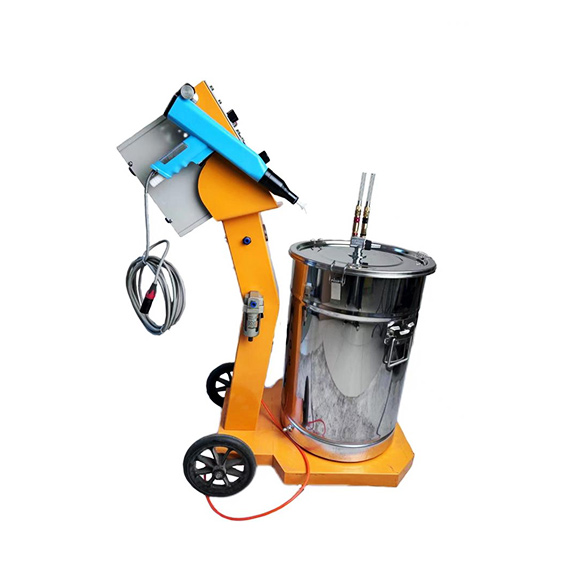
Electrostatic Powder Spraying System JL10-1A
Electrostatic Powder Spray Equipment
Shop electrostatic powder spray equipment, powder spray equipment, and powder spraying systems. Get flawless finishes & fast delivery. Quote now!
Technical Data
Electrostatic Powder Spray Equipment, Powder Spray Equipment, and Powder Spraying System: The Technology Behind Modern Powder Coating
The global powder coating industry has experienced remarkable growth, driven by the demand for environmentally responsible, durable, and cost-effective surface finishing. At the center of this evolution lies a family of equipment described by three terms that often appear together in technical literature, procurement documents, and production planning meetings: Powder Spray Equipment, Electrostatic Powder Spray Equipment, and Powder Spraying System. While these terms are clearly related, each defines a distinct scope of technology—from the basic application tool to a fully integrated finishing cell. Understanding their differences is essential for any operation seeking to optimize coating quality, material efficiency, and long-term profitability.
Powder Spray Equipment: The Broad Application Category
Powder Spray Equipment is the most encompassing term. It refers to any device or assembly used to project dry powder coating material onto a surface. In theory, this could include simple fluidized-bed dipping equipment or even non-electrostatic application methods, but in modern industrial practice, the phrase almost exclusively denotes electrostatic application devices. A typical powder spray equipment unit consists of a spray gun, a powder feed mechanism such as a hopper or box-feed unit, a high-voltage generator, and a control module. These can be manual, where an operator holds the gun and directs the spray, or automatic, where guns are mounted on fixed stands, reciprocators, or robots. The key function of powder spray equipment is to shape the powder cloud and deliver it to the part with precision. The quality of this equipment directly determines transfer efficiency, coating uniformity, and the overall material cost per part. For many small businesses and job shops, a standalone piece of powder spray equipment is the entry point into dry finishing—simple to install, easy to operate, and capable of producing professional results.
Electrostatic Powder Spray Equipment: The Core Charging Technology
Within the broad category of powder spray equipment, Electrostatic Powder Spray Equipment is the specific, dominant type that has become synonymous with modern powder coating. It applies the fundamental principle of electrostatics: a high-voltage generator imparts a negative charge (typically up to 100 kV) to the powder particles as they exit the spray gun. These charged particles are then attracted to the electrically grounded workpiece, adhering uniformly across the surface and wrapping around edges and into recesses to overcome the Faraday cage effect. After application, the coated part enters a curing oven, where the powder melts, flows out, and crosslinks into a durable, smooth film.
The advantages of electrostatic powder spray equipment are profound and have driven the global shift away from liquid paint. First, because the powder is dry and contains no solvents, the process produces zero volatile organic compound (VOC) emissions, helping manufacturers meet stringent environmental regulations without costly abatement equipment. Second, the electrostatic attraction ensures that a high percentage of the sprayed powder reaches and stays on the part; when combined with a recovery system, overall material utilization can reach 95–98%, dramatically reducing waste. Third, electrostatic application allows for the deposition of thick, sag-free coatings in a single pass, improving productivity and cutting labor. Modern electrostatic equipment is highly controllable, with digital interfaces that allow operators or automated controllers to adjust voltage, current, and powder flow in real time, ensuring repeatable film thickness and finish quality even on complex geometries.
Powder Spraying System: The Integrated Production Cell
A Powder Spraying System represents the next level of integration. It goes beyond the spray gun and its immediate controls to form a complete application cell. A typical powder spraying system includes the electrostatic or automatic powder spray equipment, a purpose-built spray booth, a powder recovery and recycling module (cartridge filters or cyclones), a powder management center with fluidized-bed hoppers, and a centralized control panel that orchestrates the entire process. In high-end installations, the system also incorporates part-detection sensors, automatic gun triggering, and rapid color-change mechanisms.
The value of a powder spraying system lies in its ability to transform what could be a messy, high-waste operation into a clean, efficient, and fully contained industrial process. The booth safely contains the powder cloud and directs overspray to the recovery unit, which captures the powder, sieves out contaminants, and returns it to the feed hopper. This closed-loop design pushes material utilization to its maximum, cuts cleaning time between colors, and protects operators and the environment from airborne dust. A well-engineered powder spraying system can change colors in as little as 30 seconds, enabling coaters to handle a wide mix of parts and colors in a single shift without sacrificing productivity. For medium to large-scale operations, the system is the platform upon which consistent, high-quality output is built—every part receives the same coating under the same controlled conditions, drastically reducing reject rates and manual touch-ups.
Applications Across the Industry
The three levels of equipment—Powder Spray Equipment, Electrostatic Powder Spray Equipment, and Powder Spraying System—serve a vast and diverse array of industries. In the automotive sector, electrostatic equipment coats wheels, chassis, brackets, and EV battery housings with corrosion-resistant, chip-proof finishes. Architectural aluminium extruders rely on automated powder spraying systems to apply durable, weatherable coatings to window frames, curtain walls, and cladding panels, achieving color consistency and gloss retention that can last for decades. The home appliance industry uses integrated systems to coat washing machine drums, refrigerator doors, and air conditioner housings with bright, scratch-resistant surfaces. General manufacturers apply powder to shelving, furniture, fitness equipment, and agricultural machinery, benefiting from the single-coat thickness and rapid curing that powder provides. Even custom coaters and restoration shops use compact manual powder spray equipment to finish unique parts with a level of quality that liquid paint cannot easily match.
Selecting the Right Level for Your Operation
The choice between standalone Powder Spray Equipment, a set of advanced Electrostatic Powder Spray Equipment, and a complete Powder Spraying System depends on production volume, part complexity, and quality requirements. A small workshop finishing a handful of parts per day will be well served by a portable electrostatic powder spray machine that is simple to use and easy to maintain. A medium-sized manufacturer producing thousands of parts weekly will benefit significantly from a powder spraying system that captures and reuses overspray, enforces consistent application parameters, and enables fast color changes. For high-volume mass production, the spraying system becomes part of an even larger automated coating line that includes pretreatment, drying, and curing—a fully integrated finishing solution. At every scale, the fundamental electrostatic technology remains the same, proving that whether you invest in a basic piece of spray equipment or a state-of-the-art spraying system, you are adopting a process that is cleaner, more efficient, and more capable than traditional wet paint.
Conclusion
Electrostatic Powder Spray Equipment, Powder Spray Equipment, and the Powder Spraying System form a clear progression of capability in the powder coating industry. Powder spray equipment is the essential tool; electrostatic equipment is the proven technology that makes dry finishing environmentally and economically superior; and the powder spraying system is the integrated cell that delivers maximum efficiency, cleanliness, and process control. Together, they underpin the global shift toward sustainable manufacturing, offering manufacturers in every sector a reliable path to high-quality, durable finishes that meet the demands of both regulators and customers. As the industry continues to innovate with smarter controls, faster color changes, and even greater material efficiency, these three pillars of powder application will remain at the heart of modern surface finishing, turning raw powder into a flawless protective and decorative layer on products we use every day.