

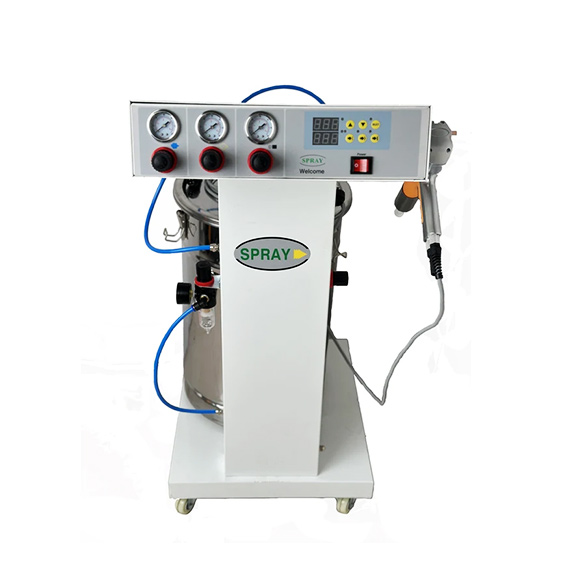
Powder Coating System B5
Industrial Powder Coating Machine
Shop industrial powder coating machines, powder coating systems, and powder coating machines. Get flawless finishes & fast delivery. Get a quote now!
Technical Data
Industrial Powder Coating Machine: The Heavy-Duty Core of Advanced Powder Coating Systems
In high-volume manufacturing environments, surface finishing is not just about aesthetics—it is a critical production process that must deliver absolute consistency, durability, and speed, shift after shift. This is where the Industrial Powder Coating Machine distinguishes itself from the wider family of powder application equipment. While any Powder Coating Machine can apply dry powder to a part, an industrial-grade machine is purpose-built for relentless duty, integration into automated lines, and the unforgiving demands of mass production. When embedded within a comprehensive Powder Coating System, it becomes the beating heart of a finishing operation that defines the quality of products in the automotive, architectural, heavy equipment, and appliance industries.
Defining the Equipment Hierarchy
To appreciate the role of an industrial powder coating machine, it is helpful to understand the terminology that organizes powder application technology.
A Powder Coating Machine is the broadest category. It refers to any device that electrostatically charges and sprays dry powder onto a grounded workpiece. This can be a compact manual unit on a cart for a small job shop, a box-feed system for a hobbyist, or a fully automatic gun mounted on a reciprocator. All these are powder coating machines, and they share the same fundamental electrostatic principle.
An Industrial Powder Coating Machine is a specific, high-performance subset. It is an application unit engineered for continuous, heavy-duty operation in a factory setting. It is designed to run for multiple shifts with minimal downtime, to integrate seamlessly with centralized controls, and to deliver repeatable, high-quality coatings on thousands of parts per day. The term implies rugged construction, advanced controls, high powder output capacity, and compatibility with the automation and recovery infrastructure of a large-scale finishing line.
A Powder Coating System is the complete, integrated production environment. It encompasses everything from pretreatment and drying to the application booth, powder recovery, curing oven, and material handling conveyor. Within this system, the industrial powder coating machine is the core application technology, but it is surrounded and supported by the booth, the powder management center, and the environmental controls that together achieve near-zero waste and exceptional finish consistency.
What Makes a Powder Coating Machine "Industrial"?
Several design and performance characteristics elevate an Industrial Powder Coating Machineabove a standard manual or light-duty automatic unit:
Robust Construction and Durability: Industrial machines are built with heavy-duty components—reinforced gun bodies, industrial-grade high-voltage cascades, and wear-resistant powder path parts—to withstand abrasive powders, constant vibration, and thermal stress. They are rated for 24/7 operation with extended maintenance intervals.
High Powder Output and Precision Control: These machines handle large powder volumes, feeding multiple guns simultaneously from a centralized fluidized-bed hopper. They incorporate digital valve control (DVC) or similar technologies to meter powder with extreme accuracy, ensuring uniform film thickness across complex parts at high line speeds. Voltage and current are precisely regulated and can be adjusted via recipe-based automation.
Advanced Automation Capability: An industrial machine is designed to be integrated into a larger Powder Coating System. It supports automatic gun triggering, part-sensing routines, robot or reciprocator synchronization, and rapid color change sequences. Many industrial guns feature internal purging capabilities and can switch colors in seconds as part of a system-wide purge-and-fill cycle.
High Transfer Efficiency and Repeatability: In an industrial environment, every gram of powder matters. These machines are optimized for maximum first-pass transfer efficiency. Consistent electrostatic performance and accurate powder cloud shaping reduce overspray and ensure that the film thickness stays within tight tolerances, part after part, minimizing manual touch-ups and reject rates.
Smart Connectivity: Modern industrial powder coating machines are IoT-enabled. They communicate with the central PLC of the Powder Coating System, logging performance data such as voltage, current, powder flow, and gun hours. This enables predictive maintenance, remote diagnostics, and statistical process control—essential tools for manufacturers pursuing zero-defect production.
The Industrial Machine Within a Complete Powder Coating System
While a standalone Powder Coating Machine can be used in a ventilated area, an Industrial Powder Coating Machine achieves its full potential only when integrated into a properly engineered Powder Coating System. This system provides the essential infrastructure:
Automated Spray Booth: A carefully ventilated enclosure that directs overspray to the recovery unit while maintaining a clean, stable environment for the coating process.
Powder Management Center: A fluidized-bed hopper or feed system that supplies conditioned powder to the industrial guns, preventing surging and ensuring consistent density.
Recovery and Recycling Module: Cyclone separators or cartridge filter units that capture overspray, sieve out contaminants, and return usable powder to the feed system. This closes the loop and pushes material utilization to 95–98%.
Conveyor and Part Handling: An overhead or floor conveyor that moves parts through the system at a controlled speed, with part detection sensors that activate the industrial machines only when a part is in position.
Centralized Control: A PLC that governs the entire line, allowing an operator to load a part recipe that sets pretreatment parameters, gun voltages, powder flow, booth airflow, and oven temperature with a single command.
Together, these components allow an industrial powder coating machine to operate at the peak of its capability—delivering zero-VOC, ultra-efficient, and perfectly consistent coatings on an enormous scale.
Key Advantages of Industrial-Grade Equipment
Deploying an Industrial Powder Coating Machine within a fully integrated Powder Coating Systemdelivers transformative advantages for high-volume manufacturers:
Maximum Throughput: Engineered for speed, industrial machines apply thick, even coatings at line speeds that manual or light-duty automatic machines cannot sustain. They can coat hundreds to thousands of parts per hour, directly impacting production capacity and revenue.
Ultra-High Material Efficiency: The combination of an industrial machine’s precise powder metering and a system’s recovery unit drives material utilization to the highest possible levels, cutting the cost per part dramatically and virtually eliminating waste.
Unmatched Finish Quality and Consistency: Automated control of every parameter, from electrostatic voltage to powder cloud density, ensures that every part receives exactly the same coating. Color, gloss, and film thickness are held within extremely tight tolerances, satisfying the most demanding OEM specifications.
Lowest Total Cost of Ownership: Although the initial capital outlay for an industrial system is higher, the long-term economics are compelling. Reduced powder consumption, lower energy use due to efficient curing, fewer rejects, and minimal maintenance downtime combine to deliver a cost-per-part that small-scale equipment cannot match.
Environmental and Safety Compliance: A complete industrial system captures all overspray, emits zero VOCs, and operates as a clean, dry process. It meets and exceeds strict global environmental regulations while providing a far safer workplace than solvent-based paint lines.
Applications Across Core Industrial Sectors
The Industrial Powder Coating Machine is the backbone of finishing in industries where failure is not an option:
Automotive and Commercial Vehicles: Wheels, chassis frames, suspension components, engine parts, and EV battery housings are coated with industrial systems to achieve corrosion resistance that withstands years of road salt, stone chipping, and thermal cycling.
Architectural Aluminium and Steel: Massive volumes of window profiles, curtain wall sections, cladding panels, and structural steel are powder coated on high-speed horizontal or vertical lines. Only industrial-grade equipment can maintain the color and gloss consistency required across entire building facades.
Heavy Equipment and Agricultural Machinery: Bulldozer arms, tractor chassis, harvester components, and construction equipment require thick, impact-resistant coatings. Industrial machines, often robotic, are used to apply functional epoxy and polyester powders that guard against extreme abrasion and chemical exposure.
Home Appliances: The bright white finishes on washing machines, refrigerators, and dryers are the result of massive, automated powder coating systems using rows of industrial automatic guns to coat parts on high-speed conveyors.
General Manufacturing and Metal Furniture: Industrial machines coat everything from office furniture and shelving to electrical enclosures and fitness equipment, providing a combination of durability, texture, and aesthetics that liquid paint cannot economically replicate.
From General Machine to Industrial System: Making the Right Choice
It is important to recognize that not every coating need calls for an Industrial Powder Coating Machine. A custom motorcycle shop coating one-off parts will be exceptionally well served by a high-quality manual Powder Coating Machine—a compact, mobile unit that offers complete operator control. A medium-sized job shop might invest in a packaged Powder Coating Systemwith a semi-automatic setup and a small recovery booth. The transition to industrial-grade equipment becomes necessary when production volumes grow, when multiple shifts are running, or when a customer demands documented process consistency and zero-defect quality levels. The industrial machine represents the top tier of a spectrum, and each level below it has a valid and profitable place in the market.
Conclusion
The Industrial Powder Coating Machine is far more than a scaled-up Powder Coating Machine; it is a purpose-engineered manufacturing tool that operates at the intersection of speed, precision, and reliability. When integrated into a full Powder Coating System, it delivers the highest performance that modern dry finishing can offer—zero emissions, near-perfect material usage, and a flawless, durable finish on an industrial scale. From the automotive assembly line to the architectural extrusion plant, the industrial powder coating machine and its surrounding system represent the definitive solution for manufacturers who demand not only a beautiful finish, but a finishing process that is profitable, sustainable, and absolutely dependable.